
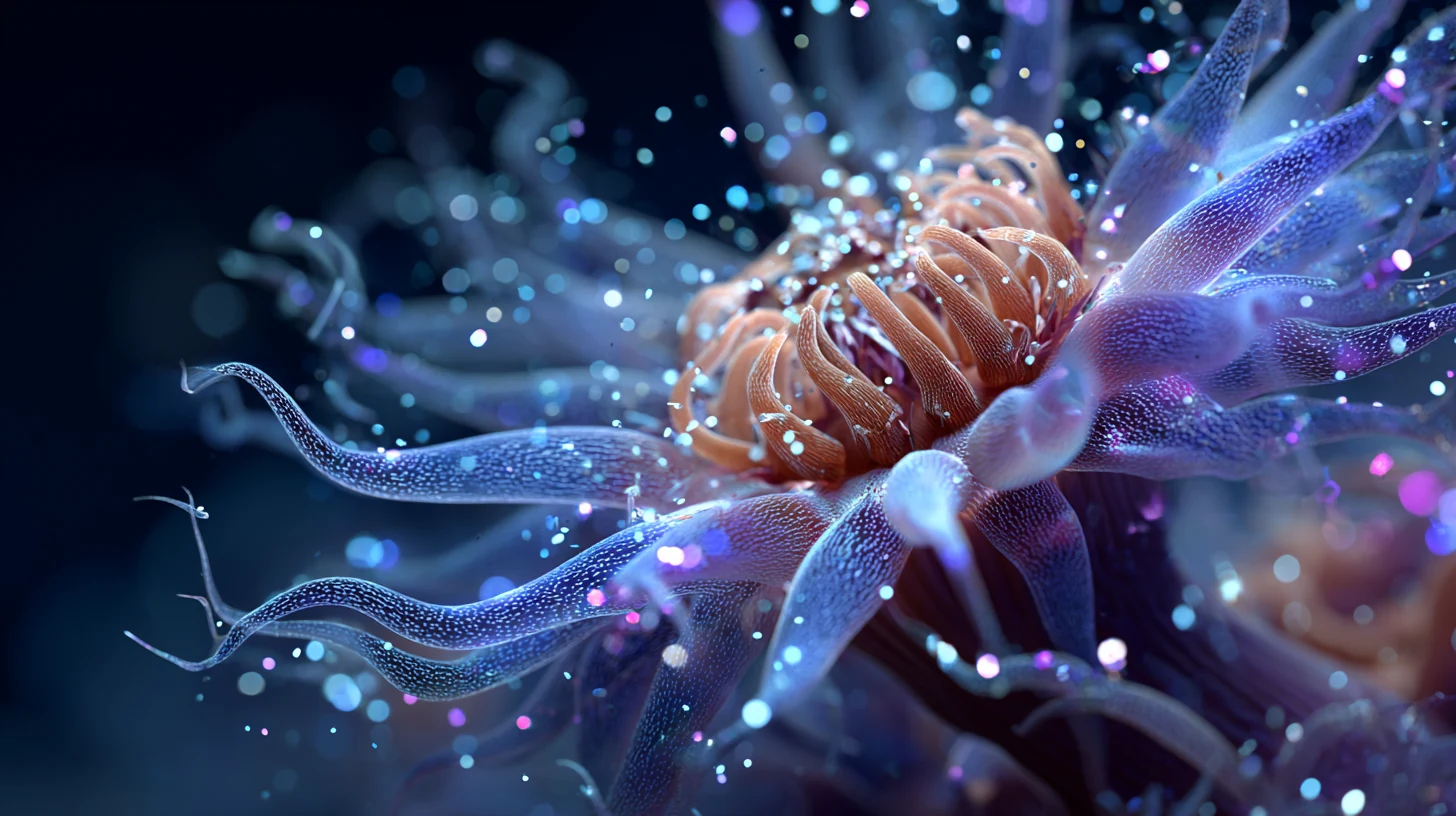
Coral heterotrophy and the science of feeding
In the hobby a coral is often described as an animal that lives almost entirely off light, drawing its nutrition from the photosynthesis of its symbionts. That is true for energy, but not for building blocks — and that distinction is exactly why feeding matters. Corals are mixotrophs: they combine two completely different modes of nutrition, the autotrophy of their endosymbiotic algae (manufacturing organic compounds from light) and the animal’s own heterotrophy (capturing food from the water). I have covered the basic biology of the symbiosis elsewhere; this article focuses on the heterotrophic side — and specifically on two questions the hobby literature rarely answers precisely: how large is the contribution of heterotrophy, and what does the coral actually retain from its food?
The answer is changing. Peer-reviewed work from 2025 shows that heterotrophy has probably been underestimated for decades — not because corals eat little, but because the metrics used measure the wrong thing. This article unpacks the mechanism, the biochemistry of digestion, and how it all translates into practical feeding decisions.
More on the basic biology of the symbiosis: Zooxanthellae and the coral symbiosis. On plankton biology and the food web: Zooplankton and phytoplankton — biological foundation.
Energy from light, building blocks from food
It is important to get the starting point right. Under good conditions zooxanthellae can cover more than 90 percent of a coral’s energy needs — this is the core of the symbiosis, and it is not in conflict with heterotrophy. The catch is that the products of photosynthesis are very rich in carbon but poor in other elements. Translocated sugar and glycerol are pure energy, but they contain little nitrogen (N), phosphorus (P) or certain fatty acids. These are precisely what the coral needs to grow: protein synthesis requires nitrogen, cell membranes require fatty acids, and the organic matrix of the skeleton requires protein.
A classic review (Houlbrèque & Ferrier-Pagès 2009) summarised it well: fed corals double their organic matrix synthesis, calcification rate, and protein and lipid content compared with starved corals. Leal and co-workers (2014) report the same finding in a broad aquaculture review. Heterotrophy is therefore not an energy source alongside photosynthesis so much as a source of building blocks — the ones light cannot produce. This division, energy from light and building blocks from food, is the thread running through the whole article.
Why heterotrophy has been underestimated
Measuring the contribution of heterotrophy has proven surprisingly difficult, and that difficulty explains why its importance has likely been downplayed.
The most common method has been the ratio of stable carbon isotopes. In shorthand, Δ¹³C is the difference between the carbon-isotope ratio of host tissue and that of the symbionts (δ¹³C_host − δ¹³C_symbiont), and it has been used as a proxy for heterotrophy for decades. The idea is that captured prey brings “heavier” or “lighter” carbon into the tissue than photosynthesis does, so the difference reveals how much the coral has eaten.
There is a fundamental problem with this. The holobiont recycles carbon extremely tightly between host and symbionts, and the isotope value is affected by many factors other than feeding — the symbiont genotype, lipid consumption, photosynthetic efficiency. When carbon constantly cycles back and forth between the partners, it is nearly impossible to trace where a given carbon atom originated.
This is where recent research strikes. Love, Stuhr and co-workers (2025, Communications Biology) grew Stylophora pistillata along a controlled feeding gradient — from pure autotrophy (no feeding) to pure heterotrophy (abundant feeding with Artemia nauplii) — and simultaneously tracked both fatty acids and carbon and nitrogen isotopes. The result was revealing: fatty acids and nitrogen were effectively incorporated into both host and symbiont tissue with feeding, but carbon — exactly what the conventional metric measures — was not. In other words the coral retained nitrogen and fatty acids from its food but burned off the carbon it ate in its metabolism. The carbon-isotope metric therefore does not see heterotrophy, even though the tissue was clearly enriched from food.
This leads to the authors’ central conclusion: methods relying on carbon isotopes systematically underestimate the importance of heterotrophy in a common reef-building coral. In practice, corals eat more, and benefit more from feeding, than established measurement methods have suggested. It is a good example of how a measurement method can shape an entire field’s understanding — and of why, in a deep dive, it pays to read the methods, not just the conclusions.
What a coral retains from its food
The most important contribution of the Love & Stuhr study is not mere methodological critique but the concept of selective nutrient incorporation: the coral does not use captured prey evenly, but selectively picks out the components it is short of.
The mechanism is logical once it is joined to the biology of the symbiosis. The coral already has plenty of carbon — photosynthesis produces it in abundance. Nitrogen, by contrast, is the limiting factor in a nutrient-poor environment, and many long-chain fatty acids the coral cannot make itself. So the carbon of captured prey is fit to be burned for energy (and exhaled as carbon dioxide), while nitrogen and fatty acids are stored in the tissue as building blocks. The study measured this directly: the nitrogen isotope value (δ¹⁵N) of fed corals rose clearly towards the value of the prey — by about +2 ‰ in corals fed twice a week and about +3.7 ‰ in those fed six times a week — and the tissue carbon-to-nitrogen ratio (C:N) fell towards that of the prey. Several “heterotrophic marker” fatty acids from the prey accumulated in the tissue with feeding.
This selectivity also explains an apparent paradox. When a coral is fed, its growth and condition improve clearly, but zooxanthellae density does not necessarily change much. In the Love & Stuhr data fed corals nearly doubled their calcification rate compared with unfed ones, and total chlorophyll rose by 58–95 percent depending on feeding frequency — yet the increase in symbiont density remained statistically non-significant. The same phenomenon recurs in a Goniopora columna study (Ding, Sun & Pan 2021): feeding clearly improved growth even though symbiont density (about 4.0 × 10⁷ cells per square centimetre) and chlorophyll content stayed essentially unchanged. The benefit of feeding therefore goes directly to the animal as building blocks, not indirectly via the symbionts.
I cover the flow of fatty acids through the food web in more detail here: Zooplankton and phytoplankton — biological foundation.
Capture and digestion — the biochemistry of feeding
To extract building blocks from food, it must first be captured and digested. The capture mechanisms are varied: the stinging capsules (nematocysts) of the polyp’s tentacles immobilise live prey, a mucus net and its ciliary transport collect fine particulate matter toward the mouth, and to digest larger prey the coral extrudes its digestive filaments (mesenterial filaments) even outside the polyp. Which mechanism dominates depends on the species and the size of the prey — mouth size is in practice the best predictor of what a coral can eat.
A remarkably precise picture of digestion biochemistry comes from the Goniopora columna study, in which the coral was fed for eight weeks on four different diets: an animal-protein-rich artificial feed containing polyunsaturated fatty acids (PUFA), yeast (Saccharomyces cerevisiae), and two microalgae (Isochrysis galbana, Nannochloropsis oculata). The result is instructive for two reasons.
First, coral tissue is protein-dominant — there is more protein than carbohydrate or fat — and among its digestive enzymes the protease (a protein-cleaving enzyme) is the most prominent. This means the coral is built specifically to exploit protein, which fits with the nitrogen finding of the Love & Stuhr study. The protein-rich artificial feed produced clearly the best growth: polyp count increased by 40–47, far more than with the other diets, and both protease activity and tissue protein content were highest in this group.
Second, digestion has a clear daily rhythm. When the researchers followed the same coral’s digestive enzymes over a 24-hour cycle, protease activity was highest at midday (12:00) — 2.5 times the value at 06:00 and about 2.3 times the value at midnight. Tissue protein content also peaked at midday and fell towards evening. The conclusion was that G. columna digests and absorbs food most efficiently between 06:00 and 12:00, when enzyme activity rises and nutrient uptake is best.
There is an important caveat here. The result concerns a single species, and the daily rhythm is species-specific — many LPS corals extend their tentacles and feed most actively in the evening and at night, matching the nocturnal rise of plankton on a natural reef. The Goniopora result therefore does not mean all corals should be fed in the morning, but that digestion is an active, rhythmic process whose timing matters.
The species-specificity also shows in a more fundamental question: does the coral eat, or merely react? According to hobbyist observations, some soft and non-photosynthetic (NPS) corals as well as corallimorphs close around powdered food but reopen an hour later with the food still undigested — this may be a mechanical irritation response rather than feeding. In some species the so-called “mouth” may function more as an excretory orifice, with nutrition taken up rather as dissolved matter directly through the tissue. This remains an open question, to which I return at the end.
I cover species-specific feeding at the practical level here: LPS corals in practice.
Dissolved nutrients and fish as a nutrient source
So far the discussion has been about particulate food — prey the coral captures. But a significant part of a coral’s heterotrophic nutrition comes in dissolved form, and requires no capture at all. This connects directly to how the system is managed as a whole.
Corals take up dissolved organic matter (DOM) and dissolved inorganic nutrients directly from the water through their tissue. On a natural reef much of this originates in the metabolism of other organisms — especially fish. Leal et al. (2014) describe the chain: grazing herbivorous fish release detrital particles from algae that the coral captures, and the fish’s faeces and the dissolved nitrogen and phosphorus it excretes the coral takes up directly. Fish excretions are, from the coral’s point of view, a nutrient supplement.
Neil and co-workers (2025, Aquaculture Nutrition) measured this effect experimentally in a way that is especially illuminating for the aquarist. They grew four coral species — two that favour fish associations in nature (Acropora kenti, Pocillopora verrucosa) and two that live without such partnerships (Porites lutea, Platygyra daedalea) — for three months under various fish-related conditions. Treatments ranged from genuine fish company to plain “fish water” (water filtered from a fish tank, with no fish), live-feed combinations, pelleted feed without fish, and a control with no fish or food.
The result: exposure to fish or to plain fish water generally raised the protein content and/or symbiont density of the coral tissue. Porites lutea grew best precisely in the fish, fish-water and live-feed combinations, while pelleted feed alone gave the weakest growth. The authors conclude that incorporating fish into coral culture provides an accessible nitrogen and phosphorus supplement specifically via the dissolved portion of the excretions. Notably, the benefit extended even to species that have no fish partners in nature — this is not a specialised symbiosis but a general nutrient phenomenon.
This measurement confirms a long-standing hobbyist intuition: feed the fish well and you feed the corals too. The same theme recurs in Reef2Reef discussions — many experienced hobbyists do not feed their corals separately at all, relying instead on an adequate fish population and its feeding to produce the dissolved nutrients the corals need. Neil 2025 gives this practice a mechanism and numbers. At the same time it ties heterotrophy directly to the system’s overall load: coral nutrition and nutrient management are not separate matters but two ends of the same chain.
More on the chemistry of dissolved organic matter: Dissolved organic carbon (DOC). On the forms of dissolved nitrogen — ammonium and urea: Ammonium and urea as nitrogen sources.
Heterotrophy under stress and bleaching
One of the most strongly documented benefits of heterotrophy concerns stress tolerance. Grottoli and co-workers (2006) showed that some corals — for example Montipora capitata — can increase their heterotrophic intake during bleaching enough to cover, temporarily, much or even all of their energy needs when photosynthesis has collapsed with the loss of symbionts. This is called heterotrophic plasticity, and it explains why well-fed corals recover better from bleaching and other stress. More recent work (Martinez & Ferrier-Pagès 2024) emphasises the importance of heterotrophy specifically during heat stress.
There is, however, an important limit that the Love & Stuhr study makes clear: feeding does not substitute for bleaching once the symbiosis has already collapsed. In their experiment bleached corals fed six times a week ate eagerly (about 19 % less than healthy ones) and accumulated protein in their tissue, but their calcification fell essentially to zero (about 0.1 mg cm⁻² per day) and their fatty-acid mass crashed — total host-tissue fatty-acid content was 75 % lower than in control corals. In other words feeding helps a coral withstand and recover from stress, but it does not work as a replacement for photosynthesis: without a functioning symbiosis a coral does not build skeleton, however much food is available.
The practical conclusion is subtle. Feeding is useful prevention and recovery support — a well-fed coral withstands a heat spike better and recovers faster — but if a coral has already bleached, the primary action is to correct the cause of the bleaching (temperature, light, stability), not to ramp up feeding.
What this means in the aquarium
The biology above translates into a set of practical feeding principles. They are not a ready dosing schedule, but a decision logic for working out when and how to feed the corals in your own system.
Separate energy from building blocks. Light is the source of energy, feeding the source of building blocks. If lighting, flow and water chemistry are in order, the coral gets its energy from photosynthesis — the job of feeding is to bring nitrogen, phosphorus and fatty acids for growth. This means feeding does not fix a lighting or chemistry problem, nor the reverse.
Feed the fish well before feeding corals separately. On the basis of Neil 2025, an adequate and well-fed fish population produces exactly the dissolved nitrogen and phosphorus that corals benefit from. In many systems this is enough, and separate coral feeding may not be needed. It is also the safest starting point: dissolved nutrients distribute evenly and do not rot on the bottom the way excess particulate food does.
Match the food to the mouth size. Large-mouthed LPS corals benefit from meaty particulate food (for example chopped shrimp, mysis), medium ones from finer particles, and small-mouthed SPS corals mostly from dissolved nutrients and fine plankton. Food of the wrong size does not benefit the coral when left undigested but instead burdens the water.
Do not overfeed. This is the biggest practical pitfall of heterotrophy. Excess particulate food the coral does not digest breaks down via bacterial action into nitrate and phosphate and can trigger algae or bacterial problems. The Reef2Reef community rule of thumb is good: dose less than the product instructions recommend, and watch the coral’s response. Caution is also warranted with amino-acid products — heavy use can feed dinoflagellates.
Use the daily rhythm. Because digestion is a rhythmic process, feeding is best timed to a moment when the coral is active — for most LPS corals in the evening, with the tentacles out. Briefly slowing the pumps during feeding improves the food’s contact with the polyps.
Remember that feeding supports stress tolerance but does not replace it. A well-fed coral withstands and recovers better, but a bleached coral is not saved by feeding — there, the cause is corrected first.
Open questions and uncertainty
Heterotrophy is an area of active research, and in fairness several key questions remain open.
Eating or digesting? As noted above, it is not certain whether all corals — especially many NPS corals and corallimorphs — digest the powdered food offered to them, or merely react to it mechanically. Controlled digestion experiments are few, and much hobby practice rests on observing the polyp’s response, not on verified nutrient uptake.
The role of bacterial plankton. It has been shown that many corals — including SPS — selectively eat certain bacterial genera (Pelagibacter, Prochlorococcus, Synechococcus) that are most abundant in natural reef water. This may be a significant but poorly managed part of coral nutrition in the aquarium, and there are few reliable commercial products for culturing these bacteria. The topic is interesting but for now more hypothesis than established practice.
How much, exactly? Although Love & Stuhr 2025 shows that heterotrophy has been underestimated, it does not give a single figure for how large the contribution of heterotrophy actually is across species and conditions. Selective incorporation means the proportion depends on which element is considered — for nitrogen heterotrophy may be decisive, for carbon marginal. There is therefore no single “heterotrophy percentage”.
Despite these open questions the direction is clear: heterotrophy is more important to a coral than the “animal living on light” picture suggests, and its importance is highlighted specifically through building blocks and stress tolerance. For the aquarist this means feeding should not be ignored — but neither should it be over-emphasised at the expense of photosynthesis and water chemistry.
More on practical feeding and dosing: Zooplankton and phytoplankton in practice.
References
Peer-reviewed studies
- Love, A. M., Stuhr, M. et al. (2025). Selective nutrient incorporation may underestimate heterotrophy of a mixotrophic reef-building coral. Communications Biology, 8, s42003-025-08621-8. https://www.nature.com/articles/s42003-025-08621-8 (PMC: https://pmc.ncbi.nlm.nih.gov/articles/PMC12381372/)
- Neil, R. C. et al. (2025). Improving Coral Grow-Out Through an Integrated Aquaculture Approach. Aquaculture Nutrition, 2025, 1446195. https://onlinelibrary.wiley.com/doi/full/10.1155/anu/1446195 (PMC: https://pmc.ncbi.nlm.nih.gov/articles/PMC12009681/)
- Ding, D.-S., Sun, W.-T. & Pan, C.-H. (2021). Feeding of a Scleractinian Coral, Goniopora columna, on Microalgae, Yeast, and Artificial Feed in Captivity. Animals, 11(11), 3009. https://www.ncbi.nlm.nih.gov/pmc/articles/PMC8614412/
- Houlbrèque, F. & Ferrier-Pagès, C. (2009). Heterotrophy in tropical scleractinian corals. Biological Reviews, 84(1), 1–17. https://doi.org/10.1111/j.1469-185X.2008.00058.x
- Grottoli, A. G., Rodrigues, L. J. & Palardy, J. E. (2006). Heterotrophic plasticity and resilience in bleached corals. Nature, 440, 1186–1189. https://www.nature.com/articles/nature04565
- Martinez, S., Grover, R. & Ferrier-Pagès, C. (2024). Unveiling the importance of heterotrophy for coral symbiosis under heat stress. mBio, 15, e01966-24. https://pmc.ncbi.nlm.nih.gov/articles/PMC11481558/
- Leal, M. C., Ferrier-Pagès, C., Petersen, D. & Osinga, R. (2014). Coral aquaculture: applying scientific knowledge to ex situ production. Reviews in Aquaculture, 6(1), 1–18. https://doi.org/10.1111/raq.12087
Reviews and hobby literature
- Wingerter, K. (2017). The Carbon Continuum: Heterotrophic Bacterioplankton and Reef Food Webs. Reefs.com. https://reefs.com/
- Riddle, D. (2015). Coral Nutrition, Part Five: Fatty Acids, Including Omega-3 and Omega-6 FAs. Advanced Aquarist / Reefs.com. https://reefs.com/
- Salem (2025). Coral Nutrition: Should You Feed Your Corals? Reef Therapy Podcast, episode 127, Reef Builders.
Hobby communities
- Reef2Reef — What does everyone feed their coral? https://www.reef2reef.com/threads/what-does-everyone-feed-their-coral.866822/
- Reef2Reef — Feeding LPS — is Reef Roids enough? https://www.reef2reef.com/threads/feeding-lps-is-reef-roids-enough.573317/