
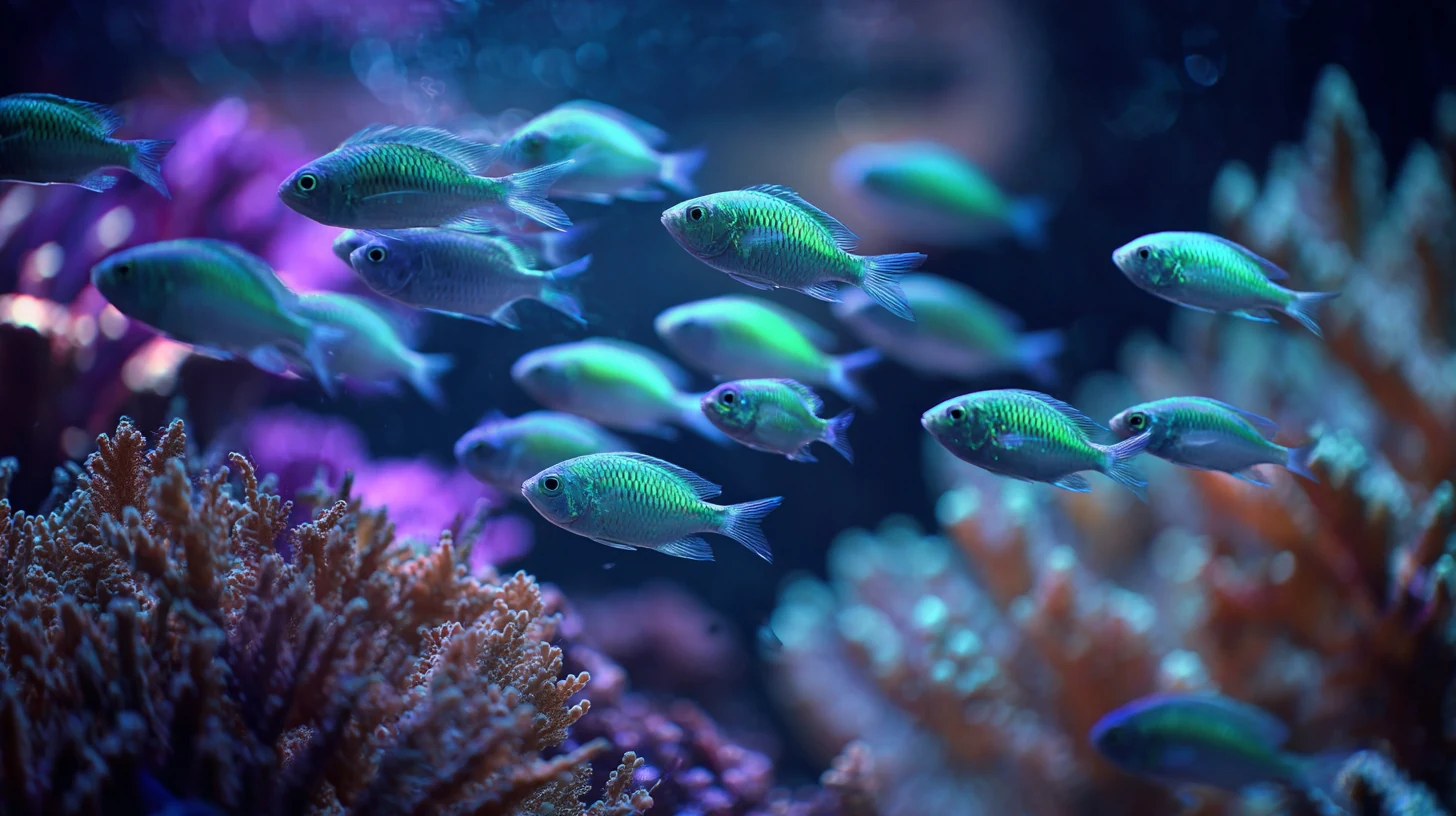
Biological load and fish quantity
“How many fish will fit in the tank?” is one of the most common questions in the hobby. It usually gets a poor answer: some rule of thumb relating fish length to water volume. The better answer is not a number but a concept. A tank holds exactly as many animals as it can process without nutrients running away and stability suffering. This processing capacity is called biological load, or bioload.
This article explains what bioload means and why it matters. It is a concept, not a formula — and an exact fish count cannot be derived from a number. The practical planning of a fish population (species selection, stocking order) is covered in its own article: Fish selection and compatibility.
Load, not head count
Bioload means the combined metabolic load of the animals — the flow of waste and nitrogen compounds they produce as they eat and excrete. It is not the same as the number of fish, nor their combined length. What matters is the mass of the animals and how much they eat.
A useful way to think about it is biomass. A tank holds only a certain amount of living mass: ten small fish of ten grams each produce roughly the same load as one fish of a hundred grams — both are a hundred grams of fish that eats and excretes. So head count alone says little about load. A large, actively feeding fish loads more than several small, lightly feeding ones, and a hunting predator more than a calm grazer. Growth belongs in the picture too: a small juvenile produces little load now but may multiply it many times over as an adult, so load must be judged by the size the animal will reach — not by how it looks at the moment of purchase.
Feeding is the real variable
Load is produced by every animal in the tank — fish, corals, shrimp, snails — but in practice its magnitude is governed above all by feeding. Fish are typically the single largest source, because they are the tank’s biggest and most actively feeding animals, but the variable itself is not the number of animals but how much food enters the system.
The reason is simple: everything added to the tank as food eventually becomes load — either excreted by an animal or as uneaten food that decomposes. Two things follow. First, the same fish population can be lightly or heavily loading purely depending on the feeding regime; bioload is not a fixed property but settles according to how much and how often you feed. Second, overfeeding is the most common way to overload a tank, because uneaten food is pure load with no benefit. Feeding is therefore the “control knob” through which the hobbyist most affects load — far more than through the number of fish.
Load becomes nutrients
The significance of load becomes clear when you follow what happens to food. When an animal digests food — or when uneaten food decomposes — nitrogen is released, which the tank’s bacterial population converts step by step into the less harmful nitrate, along with phosphate. The end result is that bioload turns into two measurable nutrients: nitrate and phosphate. It is from these numbers that the magnitude of the load is read in practice.
In a functioning tank no toxic ammonia or nitrite appears at all, because the bacterial population processes them immediately. If they start to appear, the load has exceeded biological capacity — this is an alarm signal, not a normal state. The more common situation is slower: nitrate and phosphate creep up as more load arrives than the system can export. Rising nutrients are not just a reading; they show up in the tank — typically as more nuisance algae and reduced stability. The chain from load to nutrients to stability is therefore direct: too much load means rising nutrients, and rising nutrients mean a harder-to-manage tank. This processing and export capacity is formed by the whole of filtration working together. More on this: Filtration basics and Phosphate — basics.
Capacity is a property of the system
The old rule relating fish length to a fixed water volume is misleading. It measures length, not mass or load, and ignores the species’ appetite and behaviour. Real capacity depends on four things at once: the tank’s water volume, its filtration and export capacity, the size and activity of the fish species, and the amount of feeding. Because no single number is enough, an exact fish count cannot be calculated with a formula — capacity is a property of the whole system, not of a fish or a litre.
Two principles help to grasp capacity. First, a larger water volume is more forgiving: more water dilutes load spikes and evens out fluctuations, while a small tank punishes overloading quickly, because the same amount of waste raises concentrations high in a small volume. Second, capacity grows as the tank matures: the bacterial population and the rest of the biology develop to match the load gradually, so an established tank withstands more than a fresh one. This is exactly why a fish population is built up gradually — you do not add all the fish to a new tank at once, but let the system grow with the load. How this is done in practice is closely tied to cycling. More on this: Cycling process.
Why balance is what matters
Bioload is fundamentally about a balance between two things: how much load the animals and their feeding produce, and how much the system can process and export. When the input exceeds capacity, nutrients rise, algae proliferate and the tank’s stability weakens — and the animals, especially sensitive corals, suffer. When the balance is right, nutrients stay under control, the tank is stable and the animals thrive.
For this reason the question “how many fish” is best turned around: not “how many will fit”, but “how large a load can this system withstand”. When you think of load as a balance rather than a head count, the size of the fish population stops being a riddle and becomes a consequence of what the tank can actually process.
References
Literature
- Borneman, E. H. (2001). Aquarium Corals: Selection, Husbandry, and Natural History. TFH Publications / Microcosm. (Nutrient load and the biological capacity of a tank.)
- Sprung, J. & Delbeek, J. C. The Reef Aquarium (Vol. 3). Ricordea Publishing. (Nutrient management and stocking.)
- Fenner, R. M. (2001). The Conscientious Marine Aquarist. Microcosm / TFH Publications. (Stocking, load and compatibility.)
Hobby literature and sources
- Bulk Reef Supply (2023). How Many Fish Can You Have In a Saltwater Tank? https://www.bulkreefsupply.com/content/post/how-many-fish-can-you-have-in-a-saltwater-tank
- Holmes-Farley, R. Randy’s Reef Chemistry Articles collection (nutrients: nitrate, phosphate, and the effect of feeding). Reef2Reef. https://www.reef2reef.com/threads/randys-reef-chemistry-articles.174821/
Hobby communities
- Reef2Reef — Bioload. https://www.reef2reef.com/threads/bioload.188291/
- Reef2Reef — Poll: How Many Fish per Gallon? https://www.reef2reef.com/threads/poll-how-many-fish-per-gallon.355641/